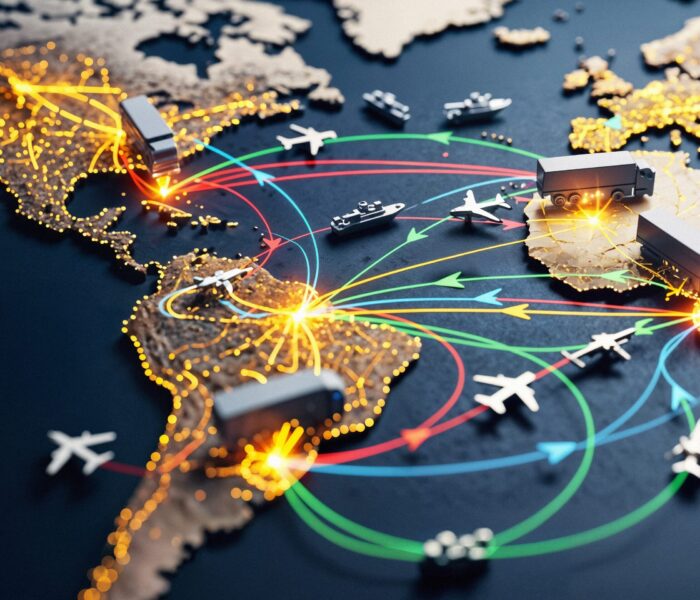

As global supply chains adapt to geopolitical disruption, shifting tariffs and new trade agreements, ten international trade corridors stand out for their commercial significance in 2027. From India–UAE trade to Africa's emerging logistics networks, these routes present opportunities for exporters, manufacturers and B2B businesses.
Global trade is entering 2027 with a changing set of priorities. Businesses are reassessing sourcing strategies, diversifying suppliers and seeking greater flexibility in how goods move between markets.
According to the World Trade Organization’s October 2026 outlook, global merchandise trade volumes are projected to grow 4.1% in 2027, following expected growth of 3.9% in 2026. The forecast reflects stronger demand for artificial intelligence-related goods and supply chain adaptation, although geopolitical uncertainty remains a significant risk.
For businesses, the next phase of international trade will be shaped not only by established shipping routes but also by regional economic agreements, industrial investment and infrastructure development.
Here are ten trade corridors worth monitoring in 2027, selected for their existing commercial scale, policy developments, strategic importance and potential relevance to UAE-based businesses.
1. India-UAE: A Growing Bilateral Trade Partnership
India and the UAE remain important trading partners, supported by their Comprehensive Economic Partnership Agreement (CEPA), which entered into force in May 2022.
Bilateral trade reached approximately US$101.25 billion in India’s 2025–26 financial year, compared with US$100.05 billion in the preceding year.
Key sectors include petroleum products, precious metals, jewellery, engineering goods, food products and electronics.
The agreement has improved market access for qualifying products and created opportunities for businesses seeking to expand their international operations.
B2B opportunity: Export distribution, food processing, logistics, industrial components and regional warehousing.
2. China-ASEAN: Asia’s Manufacturing Network
Trade between China and the Association of Southeast Asian Nations remains central to Asian manufacturing and supply chains.
The corridor connects Chinese industrial production with manufacturing and assembly operations across Vietnam, Thailand, Malaysia, Indonesia and other ASEAN economies.
Electronics, machinery, automotive components, chemicals and consumer products are among its important traded sectors.
The Regional Comprehensive Economic Partnership provides an established framework for preferential trade among participating economies.
For UAE businesses, the corridor is particularly relevant to companies sourcing machinery, electronics and manufactured goods for domestic consumption or re-export.
B2B opportunity: Component sourcing, contract manufacturing, freight forwarding and supplier diversification.
3. UAE-Saudi Arabia: Regional Industrial Integration
Trade between the UAE and Saudi Arabia benefits from geographic proximity, established transport infrastructure and economic cooperation within the Gulf Cooperation Council.
Saudi Arabia’s industrial diversification programmes are creating opportunities across construction materials, machinery, electrical equipment, food products and logistics services.
The corridor connects major commercial centres through road transport networks, ports and distribution facilities.
For UAE companies, Saudi Arabia represents an important regional market for industrial suppliers and service providers.
B2B opportunity: Construction supplies, industrial equipment, cold-chain logistics and cross-border distribution.
4. India-Middle East–Europe: A Strategic Connectivity Initiative
The proposed India–Middle East–Europe Economic Corridor (IMEC) aims to strengthen connectivity between India, Gulf countries and European markets through maritime and rail infrastructure.
Announced in 2023, the initiative envisages closer integration of ports, transport networks and digital infrastructure.
Its long-term objective is to improve the movement of goods between Asia and Europe.
However, the full corridor remains dependent on infrastructure development, cross-border coordination and regional stability. It should not yet be treated as a fully operational alternative to established shipping routes.
For the UAE, its strategic significance lies in the potential to strengthen the country’s position within interregional logistics networks.
B2B opportunity: Port services, multimodal logistics, freight technology and infrastructure investment.
5. China-UAE: Linking Manufacturing and Global Distribution
China remains a major trading partner for the UAE and an important supplier of industrial and consumer products.
According to UAE government figures, non-oil trade between the two countries reached AED180.7 billion in the first half of 2026.
The relationship covers electronics, machinery, telecommunications equipment, automotive products and a broad range of manufactured goods.
The UAE’s ports, free zones and logistics infrastructure provide opportunities for companies distributing Chinese products to Middle Eastern, African and other international markets.
B2B opportunity: Electronics distribution, automotive components, industrial machinery and re-export services.
6. UAE-Africa: Expanding South-South Trade Links
Commercial connections between the UAE and African markets are attracting attention as businesses seek opportunities in emerging consumer and industrial economies.
Trade relationships span agricultural commodities, precious metals, food products, machinery, energy-related goods and manufactured products.
African markets also present opportunities for investment in ports, warehousing and logistics infrastructure.
The African Continental Free Trade Area provides a long-term framework for greater trade integration within the continent, although implementation and market access conditions differ across countries.
For UAE-based companies, commercial opportunities vary significantly by destination, regulatory environment and infrastructure availability.
B2B opportunity: Food distribution, agricultural supply chains, logistics infrastructure and industrial equipment.
7. United States-Mexico: North American Manufacturing
The United States–Mexico trade corridor remains important for manufacturers seeking production facilities close to North American customers.
Automotive manufacturing, electronics, medical devices, machinery and industrial components are central to cross-border supply chains.
The United States–Mexico–Canada Agreement provides the regional trade framework, although tariff policy and rules-of-origin requirements remain important considerations.
For international manufacturers, the corridor offers access to integrated production networks, but commercial decisions require careful assessment of regulatory and political risks.
UAE companies supplying industrial components or investing in international manufacturing may find opportunities through established North American supply chains.
B2B opportunity: Automotive components, industrial machinery, contract manufacturing and supply chain services.
8. EU-India: A Market Access Corridor to Monitor
Trade between India and the European Union spans pharmaceuticals, engineering goods, machinery, chemicals, textiles and technology-related products.
The relationship is strategically important because of India’s expanding manufacturing capabilities and Europe’s demand for diversified suppliers.
Trade negotiations and changes to market-access arrangements remain significant factors for businesses operating across the corridor.
Companies will need to monitor applicable tariffs, technical standards, sustainability requirements and customs procedures as the relationship evolves.
For UAE-based firms, opportunities may emerge in financing, logistics and distribution services connecting Indian manufacturers with European buyers.
B2B opportunity: Pharmaceuticals, engineering exports, industrial sourcing and trade compliance services.
9. Saudi Arabia-East Africa: Red Sea Trade Connections
The Red Sea provides an important maritime link between the Arabian Peninsula and East African markets.
Saudi Arabia’s western ports connect with commercial centres in countries such as Djibouti, Kenya and Sudan, although route conditions and operational risks vary.
Food products, construction materials, machinery and agricultural commodities are among the sectors relevant to these trading relationships.
The corridor’s development will depend partly on port investment, maritime security and the reliability of shipping services.
For businesses operating from the UAE, the region offers opportunities to develop regional logistics partnerships and serve customers across the Red Sea market.
B2B opportunity: Port logistics, food supply chains, building materials and maritime services.
10. Europe-Southeast Asia: Diversifying International Supply Chains
European companies continue to assess sourcing opportunities across Southeast Asia as part of broader supply chain diversification strategies.
Vietnam, Malaysia, Thailand and Indonesia are important manufacturing locations for electronics, machinery, garments and industrial products.
Existing trade agreements, including the EU’s agreements with Vietnam and Singapore, support market access in specific bilateral relationships.
For businesses, the corridor offers alternatives for sourcing and manufacturing, although supplier capabilities, transport costs and regulatory requirements vary considerably.
UAE logistics providers and trading companies may benefit from supporting cargo movements between Asian manufacturing centres, Gulf distribution hubs and European markets.
B2B opportunity: Supplier sourcing, freight forwarding, industrial components and customs advisory services.
What Businesses Should Watch in 2027
The commercial potential of these corridors will depend on more than headline trade growth.
Companies should monitor tariff changes, customs requirements, shipping costs, port capacity, political developments and the availability of reliable local partners.
The UAE’s expanding trade relationships provide an important platform for international businesses. In the first half of 2026, the country’s non-oil foreign trade reached AED1.937 trillion, an increase of 13.1% compared with the corresponding period in 2025.
However, growth opportunities must be assessed alongside operational risks. The WTO’s 2027 trade forecast remains sensitive to geopolitical conditions, particularly disruptions affecting energy markets and major transport routes.
For B2B companies, the strongest opportunities may lie in combining market access with resilient logistics, diversified sourcing and reliable distribution networks.
As global trade evolves, the ability to respond to changing commercial conditions could become as important as the choice of trade corridor itself.
Sources: World Trade Organization, Global Trade Outlook and Statistics; UAE Ministry of Foreign Affairs, India–UAE Economic Cooperation; UAE Government Media Office, H1 2026 Non-Oil Foreign Trade Results; India Ministry of Commerce and Industry