




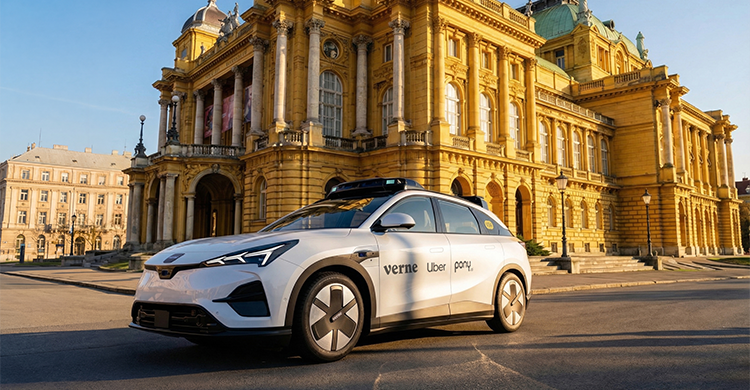

Verne, Pony.ai, and Uber have formed a partnership to deploy a commercial robotaxi service in Zagreb, with public-road testing already underway and paid operations pending regulatory approval.
The partnership separates core responsibilities across the three companies. Pony.ai will provide its Gen-7 autonomous driving system, Verne will own and operate the fleet while managing regulatory approvals and local deployment, and Uber will integrate the service into its ride-hailing platform to supply demand. This structure allows each company to focus on its core function while reducing capital and execution risk at the system level.
Zagreb is being used as an initial deployment market to validate operations, regulatory pathways, and cost structure in a controlled urban environment before expansion into larger European cities. The companies plan to scale to a fleet of several thousand robotaxis over the next few years, subject to regulatory clearance and operational performance.
Pony.ai enters the European market with prior commercial deployment experience in China, including reported unit-level breakeven in Guangzhou and Shenzhen, indicating that its system can operate at sustainable cost under certain conditions.
Uber is expected to invest in Verne as part of the partnership, reinforcing an asset-light approach in which it provides distribution without owning fleet infrastructure. Verne assumes responsibility for capital deployment and regulatory execution, positioning itself as a local operating layer for autonomous mobility in Europe.
The model reflects a broader shift toward modular commercialization in autonomous mobility, where technology providers, fleet operators, and demand platforms operate as separate but interdependent layers. Its viability in Europe will depend on navigating fragmented regulatory regimes, managing fleet economics at scale, and establishing consistent rider demand beyond early pilot markets.