
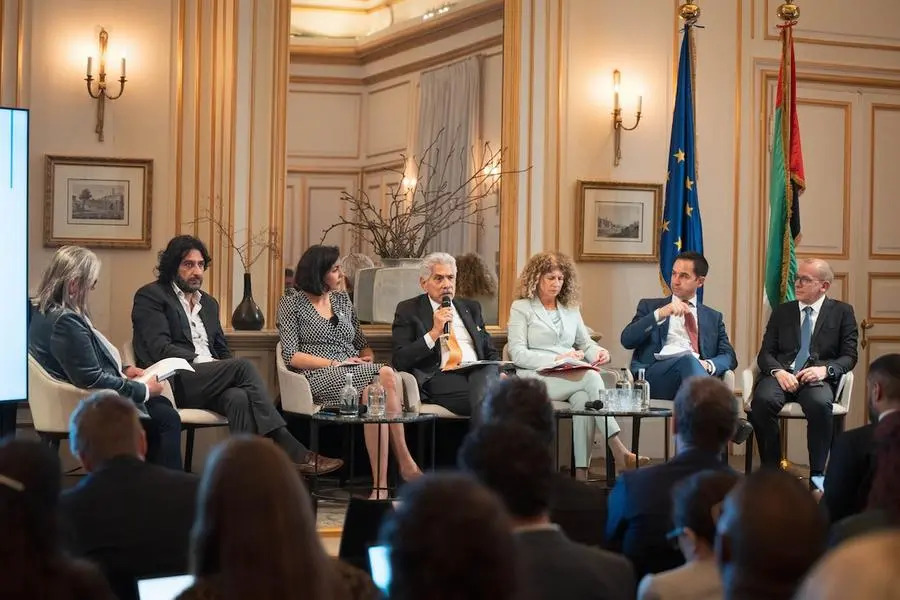
As maritime insecurity and airspace restrictions disrupt global aid flows, senior representatives from the UAE, European Union, UN agencies, and NGOs gathered in Brussels to build more resilient humanitarian logistics frameworks for an increasingly volatile world.
The UAE Embassy in Brussels, Dubai Humanitarian, and the European Commission’s Directorate-General for European Civil Protection and Humanitarian Aid Operations (DG ECHO) co-hosted a high-level panel discussion in Brussels on humanitarian supply chain resilience — bringing together more than 80 senior representatives from the European Union, the UAE, UN agencies, NGOs, humanitarian logistics experts, and private sector stakeholders.
The dialogue addressed mounting pressures on global humanitarian supply chains from conflicts, maritime insecurity, airspace restrictions, and broader logistical disruptions — and explored collaborative approaches to ensure operational continuity and sustained humanitarian access during crises.
“Millions of people around the world depend on food, fuel, and medicine delivered through the Strait,” said H.E. Mohammed Ismail Al Sahlawi, UAE Ambassador to Belgium, Luxembourg, and the European Union. “Since the shockwaves caused by COVID, the UAE has been working with our European partners to ensure we are better prepared for emergencies and that humanitarian deliveries are more resilient.”
For DG ECHO, the challenge is structural. “We need to move from siloed and often disconnected supply chains towards a coordinated and integrated network — a system that enhances preparedness, adaptability, and efficiency of humanitarian action,” said Maciej Popowski, Director-General of DG ECHO.
Giuseppe Saba, CEO of Dubai Humanitarian, framed the moment in terms of partnership: “The strength of our response lies in the resilience of our partnerships, the preparedness of the humanitarian ecosystem, and the efficiency of our logistics networks.”
The panel, moderated by Sarah Muscroft, Chief of the Response Support Branch at UN OCHA, drew on operational insights from the Dubai Humanitarian community, which has sustained aid flows to Gaza, Lebanon, Afghanistan, and other crisis-affected regions despite escalating regional instability. Its integrated logistics ecosystem, pre-positioned stockpiles, and coordinated partner network were presented as a model for resilient humanitarian hub operations.
The event built on the 2025 Administrative Arrangement between DG ECHO and Dubai Humanitarian, which has advanced closer coordination across shared humanitarian hubs, information exchange, community preparedness, and mutual operational support. Panellists identified resilience, preparedness, digitalisation, localisation, and multi-stakeholder coordination as the key pillars required to future-proof humanitarian logistics systems.
1 Comment