
Last updated:
Artificial intelligence has moved quickly from experimentation to expectation in boardrooms, but PwC’s latest Global CEO Survey suggests that most organisations are still missing key ingredients needed to turn AI into consistent business results.
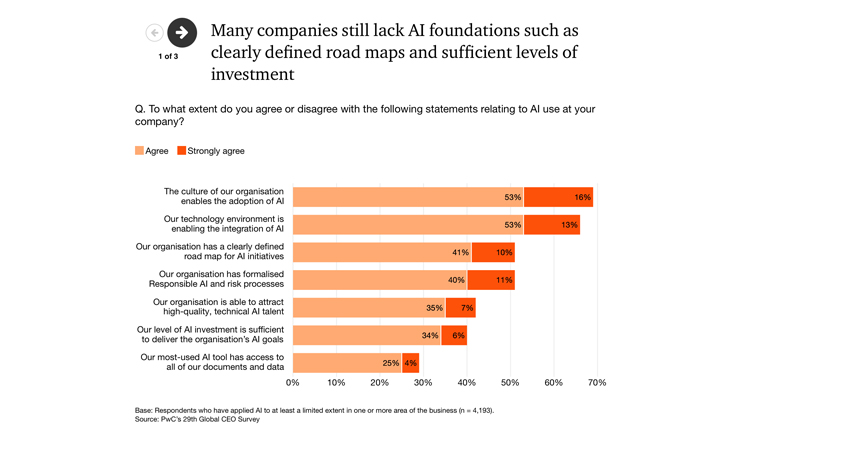
The first gap is strategic clarity. While many CEOs report that their organisational culture and technology environment support AI, just over half (51%) say their company has a clearly defined AI roadmap. Without a roadmap, AI initiatives tend to remain fragmented, making it difficult to scale use cases or align investment with business outcomes.
The second gap is investment discipline. Just 40% of CEOs believe their current level of AI investment is sufficient. This indicates that many organisations are attempting to generate AI-driven returns without committing the capital typically required to modernise data infrastructure, integrate systems or build internal capabilities.
A third constraint is data readiness. Only 29% of companies report that their AI tools have access to all relevant organisational documents and data. For CEOs, this suggests that AI is often being deployed in environments where it cannot see or learn from the full business context, sharply limiting its effectiveness.
What the Data Says Companies Are Missing
- Clear AI roadmap: Only 51% have one
- Sufficient AI investment: 34%
- Full data access for AI tools: 29%
- Enterprise-wide deployment: Limited outside operational functions
- Result: Only 15% of mature adopters see combined revenue and cost gains
These gaps shape how AI is ultimately used. PwC’s data shows that AI adoption is concentrated in areas such as demand generation (22%) and support services (20%), where implementation is relatively contained. Usage drops in more complex and value-critical functions, including strategic direction-setting (16%) and demand fulfilment (13%). The pattern suggests that AI is being applied tactically rather than embedded into core operating models.
The financial implications are clear. Among organisations that have addressed these foundational gaps, 15% report achieving both revenue growth and cost reduction from AI investments. Among those that have not, just 5% report similar outcomes. In effect, returns are accruing to companies that treat AI as enterprise infrastructure, rather than as a collection of tools or pilots.
For leadership teams, the survey reframes the AI challenge. The question is no longer whether to adopt AI, but what is still missing in strategy, investment and data integration to allow AI to move from experimentation to material impact.